
Lieury
History
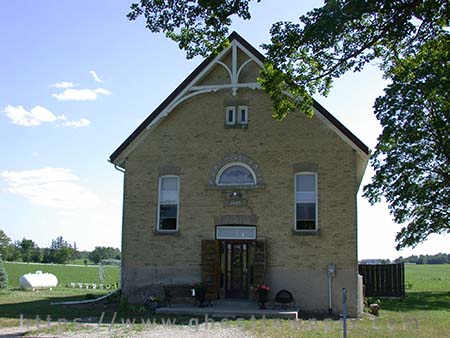
©Jeri Danyleyko
Lieury began as small supply hamlet in Middlesex County. It first sprang to life in the early 1850s.
Lieury’s first school, S.S. #10 opened around 1855. Robert Scott sold the community a quarter acre of land, located on part Lot 15, Concession 16 for the sum of three pounds. A store and church quickly followed.
With the opening of Alexander Smith’s store in 1858, Lieury began to take on the semblance of a community. There were two churches, a Baptist Church, built just west of the store in 1861, and a Methodist Church on the east side. This small, nameless, centre eventually became known as Smith’s Corners, a name that remained in use for many years.
The matter of Lieury’s name came up when Smith opened a post office in 1871. The Scottish-born Smith wanted to use the name “Lieurary,” after his birthplace. That name proved to be too difficult to pronounce so they shortened it to Lieury.
By 1880 Lieury boasted a population of around 75. The community included a carriage shop owned by T.T. Hymers, three carpenters, T. Buchanan, William Paterson and George Rotobham and a blacksmith. There were two lumber dealers, James Baxter and Richard Waistell, and a brick and tile yard owned by William Smith. Farm-based businesses included two apiarists, John Durr and John Neil, and a stockbreeder, William Paterson. For personal needs there was a tailor, W. McCartney and a shoemaker, James Ross.
Around 1880, Alex Smith donated a piece of land for construction of a Presbyterian Church, known as the McGillivray Presbyterian Church (later Lieury United Church). Considering Lieury now had three churches, it should come as absolutely no surprise that there was also a busy Temperance Hall. Members were encouraged to make a written statement that they were abstainers and also to unite others in their cause.
The 20th century brought a number of changes to Lieury. Alex Smith, one of the earliest settlers who gave the hamlet its name, passed away in 1903. His son Alex F. took over both the store and post office. They replaced the old school in 1907. The post office closed in 1913 with the arrival of rural mail delivery. The Methodist Church closed, followed by the Baptist Church in 1914. They demolished both buildings and later reused the materials. That left only the Presbyterian Church, which joined with the United Church in 1925.
Another event that took place in 1925 had a far more long-lasting effect. It began with a group of young men and women, all sports enthusiasts, who decided they needed a ballpark and playground. They turned to the community for donations and were able to raise enough money to buy one acre of land located on Part Lot 16, Conc. 16. One month later a fenced-in park with a baseball diamond opened.
The store continued to operate for a number of years. Following Alex Smith Jr.’s death, Milton Smith took over ownership and operation of the store, adding gas pumps for the convenience of the farmers. The building moved to a nearby farm after the store closed.
The park saw ongoing improvements over the years. However by far the most important changed began in 1952 with the renaming of the park to “McGillivray Memorial Park.”
Improvements followed. They enlarged the park ay about three acres and added an athletic field, bleachers and playground. To encourage families, they also added picnic tables and a concession booth. In 1956, they moved a cenotaph honouring 16 World War I veterans from West McGillivray to the memorial park. This was indeed a fitting tribute to the men who gave their lives for their country.
Today there are few reminders of Lieury’s early history. The community still contains about a dozen homes but there are no institutions or businesses to speak of. The school still stands and is now a private home. The United Church lasted until 1999. The building in turn closed and the congregation transferred to Parkhill. Like the school, the church is now a private home. The park remains well maintained with improvements made as needed. It is open to the public year round.