
Sauble Falls
History
©Jeri Danyleyko
Long before Sauble Beach and Sauble Falls became the playgrounds of Bruce County, the area was home to far more serious business. Lumbering was the big game in the Sauble Falls during the latter part of the 19th century. Once the timberlands opened, numerous sawmills quickly dotted the landscape. Nearby communities such as Wiarton, with its three furniture factories, thrived due to their close proximity to the mills.
Sauble Falls was an ideal location for a mill site. The falls offered an abundant source of power along with the availability of tug or paddleboat to haul the logs to the vast reaches of Lake Huron for transport to the large US and Canadian markets.
The townsite was first settled in 1864. By 1867, the lumber mill was in operation. Throughout the 1870s, the townsite continued to grow. This included a large boarding house, general store and blacksmith. Wilson Stewart opened a post office in 1875. A school followed in 1880.
By the mid-1880s the population had grown to about 80 and Sauble Falls had acquired two churches, Methodist and Baptist. During this period, the McLean brothers, Hector, Lachlin, and Hugh, were running the sawmill. Their tenure was possibly the longest in the sawmill’s history. The operation included a large saw and shingle mill that produced lumber, lath, shingles and telegraph poles. The McLeans used a steam-driven tug, the Sauble Queen, to haul logs and raft the timber over to Southampton and Port Elgin. To transport the logs upstream, they used a small paddleboat named the “Water Witch.”
The McLeans should have made a fortune, but one disaster after another plagued the mill. First came the loss of the Sauble Queen, which burned right down to the waterline in the middle of the night. Next up were the mill fires. After several small fires, a huge inferno consumed the entire mill resulting in the devastating loss of 43,000 meters of sawed lumber. After they rebuilt the mill, there was still employment for 30 hands, 20 at the mill and another 10 in the woods, cutting.
By the 1890s, Lowery and Sylvestor owned the mill. Murdock and Leeson took over the general store and William Gerrie manned the post office. Rural mail delivery finally arrived in 1916.
In 1905, J.C. Thede, began construction of a new power generator at Sauble Falls. Citizens of the nearby town of Wiarton must have been jumping for joy. For several years the town was embroiled in a bitter dispute with their power supplier, CFM, over the supply and cost of electricity. CFM, who was losing money on the operation, even went so far as to raise the price of electricity by 50%, infuriating local citizens in the process. The new plant built by the Sauble Falls Light and Power Company harnessed water from the sawmill into a generator. The new plant was ready in August 1907 and Wiarton ended its dealings with CFM.
Lumbering continued on at Sauble Falls until the late 1920s and depletion of the lumber supply. The Foshay interests bought the power plant in 1928 but their monopoly didn’t last long. Following bankruptcy the following year, Ontario Hydro took over the plant. Fire finally consumed the mill for good in 1937. The school lasted somewhat longer. In 1941 it took the top award in the province from a total of 232 entries for the “most improved school.” Later on it sowed the seeds for the School Forestry Club Movement, a program that spread across Canada.
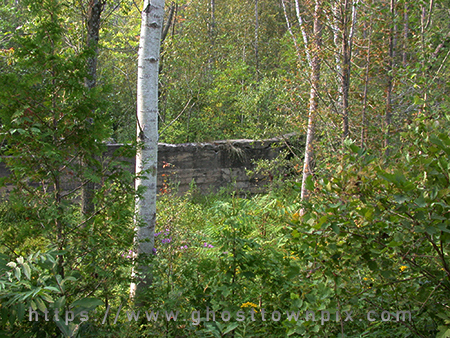
Over time they gradually dismantled the townsite. By 1957, the province had taken ownership of the area and opened the Sauble Falls Provincial Park. Today the former townsite lies within the park boundaries. Remnants of the dam and power plant can still be found in abundance near the falls.