
Dunkeld
History
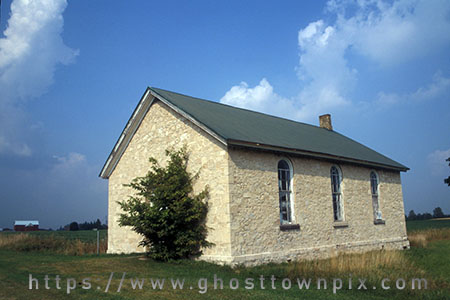
©Jeri Danyleyko
The opening of the Durham and Elora roads in the 1850s offered promising opportunities to those willing to endure a few years of hardship in the bush. Before the arrival of the railways, road access was the only means of transportation and communication. New settlements along the roads were widely considered to have unlimited potential for growth.
John Eckford was one of the first of two settlers to take up land along the new Elora road, likely the first. He is also one of Dunkeld’s most prestigious. Eckford is quite an intriguing individual. He was 52 years old when he and his family arrived from Scotland in 1851. Eckford, who had spent twenty-five years as a Presbyterian minister, arrived with the ultimate goal of finding a “desirable spot in the backwoods.” Despite his conservative religious background, he was evidently ready for new adventure.
At that point in his life, John Eckford clearly favoured public service over ministering. Although he conducted services when needed, he devoted the remainder of his life to public service. His career as a public servant began in 1857, with his election as reeve. Eckford apparently had some choice as to his appointment because he chose instead to accept the position of Local Superintendent of Schools. He later held the position of reeve for a brief period from 1869 to 70.
The Superintendent of Schools position lasted until 1871. Abolishment of the position, led to a new appointment for John Eckford, that of township treasurer. He served as treasurer until his death 10 years later. His son James then followed him into that post, which he held until 1905. Both men were held in high regard.
Hugh Bell opened Dunkeld’s first post office in 1856. William Chisholm donated a piece of property for a log schoolhouse. In the early days children from Cargill and Chepstow also attended this school. Attendance stood as high as 80 during the winter months. On Sundays the school doubled as a church. A white brick structure replaced the long school in 1871.
The post office moved to several different locations over the years. In 1861 it moved to Andrew Brown’s general store. Brown closed the post office in 1865. Bell took it over once again in 1866. In 1868, Bell moved it once again, this time to his newly opened hotel, which also contained a store. Bell only served as postmaster for another two years. There were a number of other postmasters after Bell, however the location of the post office is unclear. It appears that it moved between several different stores until 1880 when it moved back to the hotel. The last postmaster, F. Schuler, expanded his offerings to choice wines, liquors and cigars. Rural mail delivery in 1914, followed by the Ontario temperance movement put an end to all those activities.
One of the early institutions in Dunkeld was the Orange Lodge, probably formed in the 1850s. In 1868, William Garland donated a piece of property on Lot 30, Concession A, for an Orange Hall. Garland Lodge 856 was located northeast of the Dunkeld crossroads and shared with the neighbouring community of Eden Grove.
By the 1860s, the Presbyterian congregation had grown so large that meeting in the schoolhouse had become unbearably uncomfortable. John Eckford and James Young generously donated a plot of land for a limestone church. Known as the West Brant Presbyterian Church, the doors first opened in December 1869. The Reverend John Eckford returned to the pulpit to conduct the early services. A Dr. Moffat assisted him later on.
A second church, known as the Christ’s Disciples Church, was also active in the area. Many of the members had originated from Eramosa Township where this church had a large following. Members met in various peoples’ homes until the early 1870s. Their first real church was a log building, located across from the schoolhouse beside the Whitehead store. That building lasted until 1878, when the congregation relocated to a larger building in Walkerton.
The Great Western Railway (GWR) arrived in Brant Township in 1871. By 1876, Dunkeld boasted a small flag station about 1/2 kilometre west of the village. The rail yard included a siding, stockyard and scales. The Grand Trunk Railway (later CN) absorbed the GWR in 1882.
During the 1870s, Dunkeld’s residents included a framer, James Hill, Two blacksmiths, William Whitcraft and Duncan McDonald, and a horse-breeder, Thomas Stevens, owner of a stallion named “Young Champion.” Dunkeld even boasted a constable, one William Boddy. It’s unclear whether that was an appointed or volunteer position as Boddy also farmed on Lot 7, Concession B. By the late 1870s, Charles Dands was operating a lime kiln. At the time, Dunkeld’s population stood at around 75.
By the 1880s Dunkeld was a small but industrious little hamlet with a number of farm based industries. Naturally there was a flour mill, this one operated by William Austin. Two of the more interesting industries were the Dunkeld Cheese and Butter Company, and the Dunkeld Cider Manufacturing Company, which manufactured cider and apple butter. James Bell, who also served as postmaster in a previous business, owned the cheese and butter company. Frank Shuler, who apparently wore a multitude of hats, also ran the cider company.
Both the post office and the hotel went through several changes in ownership that included Joseph Fletcher, John Tschirhart (also spelled Tscheirhart) and also Frank Shuler. Tschirhart also had an association with the cider company. As well there were the usual grain and livestock dealers, blacksmiths, carpenters, cheese makers, and a wagon maker. A second cheese factory was also in operation during the late 1880s.
One of Dunkeld’s more important industries was timber shipping. Shipbuilders in the UK used an extensive amount of rock elm timber from this area. The timber was first cut and squared. The next step was to float it north to Southampton for shipping to England. Thomas Chisholm was one of the wood dealers. Chisholm was also active in the cheese factory, the Farmers’ Central Fire Insurance Company and served as a Township Council member.
By the early 1890s, Dunkeld’s population had grown to around 100. The community continued to prosper during the early part of the 1890s. Joseph Zettel took over the hotel, store, post office and cider operation. However by the close of the 19th century, Dunkeld’s population began to drop as its businesses closed or moved to larger centres, such as nearby Walkerton. The Dunkeld Cheese and Butter Company operated into the early 20th century.
Dunkeld got another school in 1909. The new building was located directly across the road from the old one. The new school saw a number of improvements over the years. These included new desks, a piano, free hot lunches during the winter and the installation of electricity in 1945. Centralization of the school system led to the school’s closure in 1968.
Also in 1909 the West Brant Presbyterian Church, built by John Eckford, closed its doors. The nearby community of Cargill was home to a brand new Presbyterian church. The area was too small to support two Presbyterian congregations so close together so the larger community won the draw. Walter Gow, a grandson of John Eckford, made a generous donation to restore the church in 1929. Henry Young supervised the restoration. On November 11, 1931, the newly restored church reopened its doors for a special memorial service. It was a fitting tribute. Col. John McCrae, who wrote the poem “In Flander’s Fields,” was John Eckford’s grandson.
By the mid-1950s, Dunkeld was little more than a small farming hamlet. The railway yards included a small station and shed on the east side of the tracks. Directly across from the station was a small freight shed. Just south of the freight shed was a turnip waxing plant and warehouse. A stock pen was located just south of the turnip warehouse.
After providing accommodation and serving suds to travellers and local residents alike, the beautiful stone hotel closed after 45 years. It was likely an unfortunate victim of Ontario’s temperance act. After serving as a private dwelling for many years, until restoration restored it to its former glory. The hotel enjoyed a prominent spot along the highway. For a number of years it operated as a restaurant, pub, and a catering and banquet facility. Sadly, fire destroyed the building in the winter of 2013.
Today there is very little left of Dunkeld. A few original buildings, including the former school and Presbyterian Church are still standing. The community continues to support a number of rural dwellers and farms.