
Lewisham
History
©Jeri Danyleyko
Lewisham’s first settlers began arriving in 1874. Lured by promises of rich, fertile, farmland available for free once they met certain conditions, one can only imagine the dismay the newcomers felt upon arriving at this remote, disgusting, mosquito infected swamp. Fortunately for the settlers, there were a few minor benefits. Amidst the rocks and bogs they discovered one tiny portion of arable land, where they set up bush farms and established a small community.
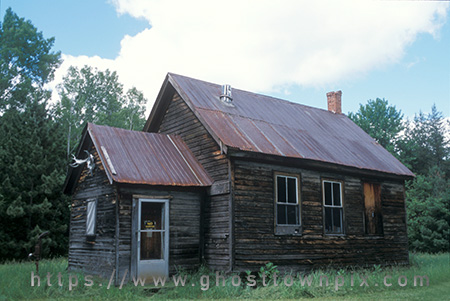
Initially the tiny settlement appeared to thrive. They opened their first school, S.S. #3, in 1879. The school was a small log structure, located on Lot 10, Concession 4, built by John Fox at a cost of $85.00. John G. Taylor served as the first schoolteacher. The village also included an Anglican church and a sawmill.
John G. Taylor was one of Lewisham’s more prominent residents. In addition to serving as the first schoolteacher, Taylor also owned the general store. In 1884 he added a post office which he named Lewisham, after his hometown in England. The mid 1880s proved to be Lewisham’s greatest boom period. The villagers kept busy shipping hay, shingle bolts, produce and lumber. Then they added a Methodist Church. The population jumped to 150 and stages were running twice weekly to Cooper’s Falls.
The confusion surrounding Lewisham’s schools was a simmering bone of contention for many years. It began in 1886 when, for some reason, the authorities split S.S. #3 into two school sections. They followed with a new log schoolhouse, S.S. #7, located just south of Lewisham. In 1895, despite the objection of many ratepayers, Ryde Council decided to reunite the two school sections.
To complicate matters even further, the original log schoolhouse, S.S. #3, burned down in 1898. A frame structure, located on Lot 5, Concession 5, replaced it. Although residents attempted a number of times to have the school sections broken up again, it never happened. The merging of the two school sections required the teachers to teach half a year in one school and half in the other. Some of the teachers refused to go along with this, leading to even more difficulties. In 1908, they finally decided to close the older of the two schools, the former S.S. #7. Eventually they sold the little log building.
By the time Lewisham’s second school closed, its best days were long over. There was barely enough justification for one school, let alone two. After hitting a peak of 150 residents during the mid 1880s, Lewisham’s population began to plummet downwards and had declined to about 50 by the early 20th century. Farming was marginal at best and the lumber supply was becoming depleted.
W. J. Tryon ran the post office from 1888 to 1890, followed by William Lowe and John Fox. Given the desolate location and dwindling population, the business was anything but a thriving success. The last owners were the Taverners, who gave up and closed up shop in 1927. The school struggled on until 1949.
By the end of the Second World War, bush farming held little attraction or appeal for anyone and Lewisham’s few remaining residents departed. With the community now virtually deserted, the roads fell into disuse and deteriorated. Looking at Lewisham now, it’s difficult to understand how it even managed to last 80 years. The area remains seasonally popular with hunters and one can find hunt camps all along the way.