
Port Milford
History
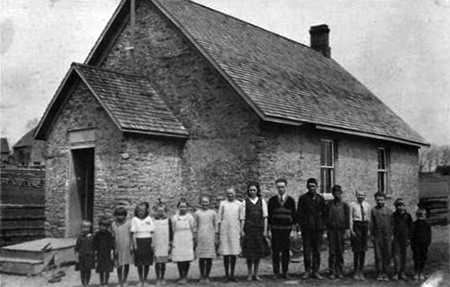
Source: Quinte Educational Museum and Archives
In these days of high-speed road and rail transportation, it’s easy to forget Ontario’s early routes were dominated not by roads but by waterways. With its southern border almost completely surrounded by the Great Lakes, tiny harbours dotted the shorelines. Traders, travelling in small wooden schooners, could easily pick up and deliver produce, lumber and all other types of locally produced goods. Port Milford was very typical of these small 19th century lakeside ports.
Port Milford got its start around the mid-1860s as a barley port. James Cooper, who had arrived from Ireland and settled in Prince Edward County in 1843, saw an opportunity in the barley trade, and made his way southward from Picton to take advantage of the anticipated boom. Cooper built docks and sturdy stone warehouses and soon his operation was humming with business. Later on his brother William joined him. Together, they expanded their little empire by building houses and adding a store.
The Cooper Brother’s success attracted others to the area. A.W. Minaker added a second store, a wharf and hotel. Earl Collier took up residence in a handsome red brick house, built by the Coopers, and later took over their general store. Collier ran the store well into the 20th century. By 1880, the Coopers had taken over Minaker’s wharf and hotel and pretty much the whole rest of the town.
The period from 1860 to 1890 was known throughout the county as “Barley Days.” Prince Edward County’s barley was highly prized by brewers who considered it to be the very best. Farmers made a veritable fortune through the sale of barley. In 1867, 330,225 they shipped 330,225 bushels of barley. By 1881, the figure had jumped to 816,132 bushels. They shipped much of the barley to New York State. Shippers would begin loading the schooners at day break. By the time they finished, they loaded 12,000 bushels and the ship left the dock. During that heady 30-year period, Prince Edward County shipped an estimated 15 million bushels of barley was shipped from Prince Edward County.
As a compliment to the booming barley industry, a ship-building industry started up in the late 1870s. The first launch took place in 1877. Fourteen more ships were to follow. Like all maritime communities, Port Milford had its black days when one ship, the Fleetwood, sank off its shores.
Shipping played a major role in Port Milford’s early days and a number of Port Milford’s residents, such as William Lobb and William Wellbanks, listed their occupations as sailors. The lush soils of Prince Edward County were perfect for agriculture and now that farmers had a nearby port, they were able to find much larger markets for their butter, cheese and apples. The shipping industry eventually grew so big that it was necessary to add a full- time customs officer, two wharffingers and a telegraph office.
It was the very success of the shipping industry that eventually left Port Milford out in the cold. As schooners grew into steamers, Port Milford’s tiny harbour could not accommodate the larger ships and the industry moved northward to the village of Picton. A second blow fell in the 1890s when the Americans hit imported barley, the mainstay of Port Milford’s exports, and widely used by the American alcohol producers, with a heft U.S. tariff.
By the 1890s, Port Milford would have been in a serious state of decline were it not for the Church brothers, Archibald and Richard. The Churches opened a brand new cannery, the Port Milford Packing Company, which luckily was an instant success with the farmers. Consequently, they could now have their freshly grown produce canned immediately.
As Port Milford’s fortunes picked up, it grew in leaps and bounds. A post office opened in 1895. By 1900, it boasted two main streets, with close to two dozen buildings along with a church and school. The population swelled to around 100.
Port Milford continued to thrive as long as the cannery remained open. When it closed in the 1930s, there were no third chances left. People abandoned the village and most of the buildings demolished. Today, all that remains are the foundations from the cannery, Earl Collier’s attractive red brick home and the general store.