
Stanton
History
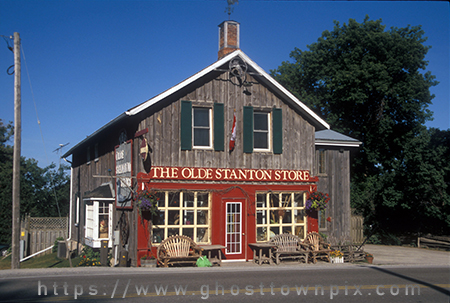
©Jeri Danyleyko
Stanton was a very early Mulmur settlement – in fact it was the second in the township. The earliest settlers, the Hands and the Walkers, first arrived in the Stanton area back in the 1820s. The Walkers owned 400 acres of land immediately next to the town site. The Hands owned Lots 5 and 6 and later purchased additional land from the Walkers. It was on this additional land where they erected the first building and the village gradually began to take form.
There was a bit of a dilemma when it came time to name the fledgling settlement. Both families held some degree of prominence in the community and each wanted the community named after them. The Walkers wanted “Walkerville” and the Hands naturally wanted “Handsville.” Sensing future discord, they made the final decision with Solomon-like precision by the thump of a judge’s gavel who proclaimed the name “Stanton.” And thus it remained.
The Orange Lodge issued the original warrant for Orange Lodge No. 80 in 1831. Following that they issued a second warrant in 1847 to William Kirkpatrick at a time when the community had the unofficial name of Handsville. They built the first hall on the 5th sideroad and later rebuilt it in the centre of the village.
An early log school was constructed on the 5th sideroad probably during the 1850s. According to the description, it was very primitive and typical of schools built during that period. The building measured about 9 X 12 metres, had two windows, one on each side, and a box stove for heating. Pupils sat along two large benches with no backs. In 1868 they built a new school, S.S. #1 just east of Stanton.
By the 1860s, Stanton had become a stopping place of sorts. In 1866 William Beatty arrived from Banda and opened the Union Hotel which also had a tavern and a store. The following year he opened Stanton’s first post office. A second hotel, the Stanton, included a store owned by James Walker. John Arthur Love, aged 28, opened a third store. Love grew to become an important mainstay of the community. Other businesses included four carpenters, a wagon and carriage shop run by Robert Summersett, two blacksmith shops, owned by Andrew Cauthers and Thomas Clothley, and a dentist, H. Robinson. Clothley later relocated to nearby Whitfield. Stanton’s population at that was around 100.
One industry that remained prominent for many years was the Boyne Mill, located about halfway between Stanton and Mansfield. Edward McMulkin, a Stanton resident, built the mill. Early history of the mill is sketchy but its arrival must have been most welcome. Up until that time the closest mill was located at Sheldon, a distance of about 20 kilometres.
During the late 1860s or early 1870s, David Gemlo took over the mill. Some sources also list Gemlo as the postmaster in Stanton however official records do not bear this out. Other industries in the area included a carding mill, run by John Cooper during the 1870s and 80s.
Stanton was a busy place during the 1870s. The village added a woollen factory and shoemaker. Both the Stanton and Union hotels were still operating. Edward Pearson expanded his cabinet making business to include carriage building. Pearson’s business operated out of the basement of his home until 1891 when he moved to Everett. Beatty gave up the post office in 1876 and John Love took over. Love served as postmaster until 1901 when he moved to Alliston, and later Toronto.
In 1870, authorities chose Stanton as the seat for a new court house after fire destroyed the old court house at Mulmur Corners. In 1881, after Mulmur became part of the newly formed county of Dufferin, they designated the court house as the “Third Divisional Court of Dufferin County.”
Stanton’s residents were politically active long before the arrival of the court house. Thomas Hand served as reeve from 1860-61 and again from 1874-76. Colwell Graham spent many years in the service of the township. This included a role as township clerk from 1859-68 and a concurrent role as treasurer from 1860-68. He also served two separate terms as reeve, first from 1869-73 and then from 1878-86. He was serving as a councillor in 1881 the year when Mulmur severed its ties with Simcoe County. Stanton’s postmaster, John Love, also served as township treasurer from 1871-93 and as the court clerk. Bailiffs included Archibald Colquhoun, Andrew Cauthers, Joseph Armstrong, who had opened a butcher shop, and his son John.
John Love was an inspiration to many. John Willison was in his mid to late teens when he arrived in Stanton during the early 1870s looking for work. Love took a liking to the youth and hired him to work in his store. Willison moved into the Love home where he lived for a number of years and developed a close bond with the family.
John Love recognized in the young man a gift for journalism rather than commerce and steered him in that direction. Willison eventually found work with a newspaper in Alliston, then moved on to London, finally ending up at the Toronto Globe (later Globe and Mail) where he became editor-in-chief at the age of 34. He was knighted in 1913 and later became president of the Canadian Reconstruction Association and president of the Canadian Colonization Association. John Willison always credited John Love for pointing him down the right path.
Love’s youngest son Thomas Alford also took up a career in journalism. Like John Willison, he began his career with the Alliston Herald, then moved on to the Toronto Star, eventually heading west where he settled in Grand Forks, British Columbia. He became publisher of the Grand Forks Gazette, served as an officer during World War I and later entered politics. After a successful 10-year stint as mayor of Grand Forks, he entered provincial politics, rising to the level of Deputy-Speaker of the house.
During the 1880s and 90s, things remained quite stable in Stanton. The community added a few new services. These included a butcher, John Armstrong and a singing teacher, John Abraham. Abraham, who lived in nearby Mansfield, began offering regular classes in Stanton. The singing classes were a bit hit with attendance in the range of 30 to 50.
By the 1880s, the school section expanded to the point where the school was severely overcrowded. Enrolment peaked at around 100. The board tried to manage the situation by dividing the room into two and hiring a second teacher. When that didn’t do the trick, they added a second room. Finally in 1882, they built a new U.S.S. school near Rosemont which freed up the extra room in the Stanton school.
Datlon McCarthy, MP for South Simcoe acquired the mill in 1876, as a result of a mortgage default. McCarthy was no miller and spent the next 17 years leasing the mill to a number of tenants, including Edward Glenning and Joseph Dixon. Poor maintenance during this period resulted in the mill gradually falling into a state of disrepair. In 1893 John Plewes purchased the mill and along with his sons made the necessary repairs and restoration in order to rebuild the business. In 1903 he retired and sold the mill to Thomas Stirling. The mill went through several other changes in ownership over the following years.
In the late 1890s William Beatty sold his hotel and tavern to James Walker and returned to his home town of Banda after spending 30 years in Stanton.
In the early days taverns were plentiful and offered a convenient source of food and respite to the many weary travellers making their way up the dirt trails by foot or oxen. As settlement increased and roads improved, the need for such a multitude of taverns diminished. The taverns however didn’t – and complaints of wanton and drunken rowdiness became such a serious matter of concern that a strong temperance movement took hold during the 80s and 90s.
In January 1900, a bylaw prohibiting the sale of liquor in Mulmur received third reading. Although the courts later quashed the bylaw on appeal, James Walker decided it was high time to get out of the hotel and booze business. The Walker family used the hotel as a home until John Love’s departure. They then bought the Love home and demolished the hotel.
During the 1890s, Andrew Cauthers, Stanton’s long time blacksmith and court bailiff, rented his shop to Thomas Long, who took over as the town smithy. After Long moved to Mansfield, Cauthers returned to his shop where he resumed work until age and poor health forced him into retirement. The building was sold to Edward Beaton and later demolished.
With the coming of the 20th century, Stanton’s role in township affairs slowly began to diminish. After John Love’s departure in 1901, Alex Ferris took over the store along with the post office and court house duties. Following his death in 1913, his son John assumed those roles. In 1914, the post office established a new postal distributing centre in Mansfield. The Stanton post office closed the following year. Rural mail delivery replaced it. The court house lasted until 1929 when the courts moved to Shelburne. The building was later sold. . The mill continued to operate until the early 1950s and possibly somewhat later.
Unfortunately today there are few vestiges of this small community that once played such an important role in the early history of Mulmur Township. Happily the general store still stands and continues in business as an antiques and craft store. One of the hotels still remains and is now a private home. Both the schoolhouse and the Boyne Mill saw renovations and are also private homes.